Cell Phone Dry Bags
The Best Cell Phone Dry Bags for 2026
Updated 2026 · 8 min read · 12 products reviewed
Affiliate disclosure — Some links on this page are affiliate links. If you buy through them, LensGripVault may earn a commission at no additional cost to you. We never accept payment for placement or rankings. Full disclosure.
Your phone is your best travel camera right up until it meets water, and then it's an expensive brick. A waterproof pouch is a few dollars of insurance that lets you keep shooting through rain, spray, and full submersion — kayaking, snorkeling, water parks, a canoe that tips. Done right, it turns 'leave the phone in the car' into 'get the shot from the water.'
The market is a sea of near-identical clear pouches, and the differences that matter are easy to miss: the actual sealing rating, whether the pouch floats if you drop it, how well the touchscreen works through the window, and whether it fits today's enormous phones with a case on. We picked six that get those fundamentals right and skip the gimmicks.
Two ratings dominate the listings: IPX8 and IP68. Both certify submersion resistance, and for a phone pouch either is what you want; IP68 additionally implies dust protection, which matters more for the phone than the bag. Whatever the label says, the real safeguard is your own seal check every single time. Below: the shortlist, an at-a-glance table, and a buying guide on ratings, floatation, and the test you should run before trusting any pouch.
At a glance
Tap a product name to jump to its full write-up.
The picks, in order
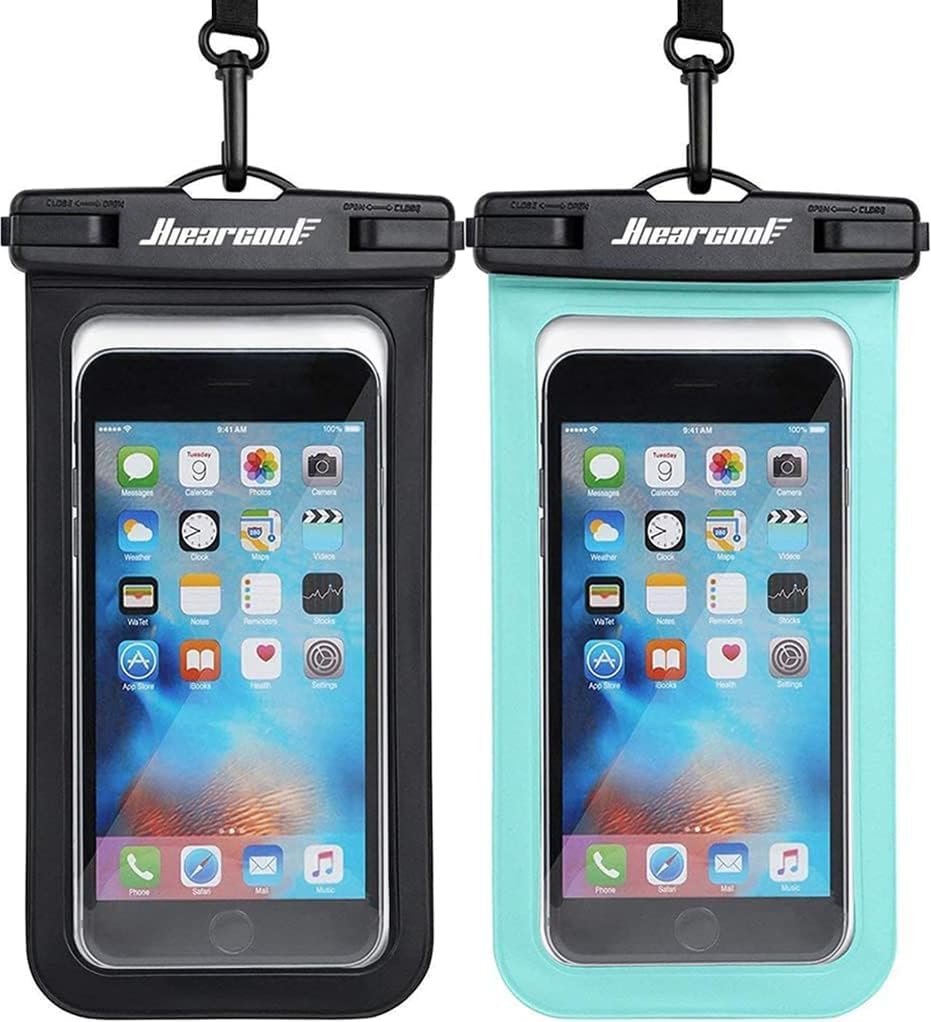
Hiearcool Waterproof Phone Pouch, IPX8 (2-Pack)
The default recommendation: an IPX8 pouch two-pack that stays fully touch-responsive underwater and fits most large phones.
Considerations
- —Photos through the window are softer than bare glass
- —Snap-lock must be closed exactly right every time

Case-Mate Soap Bubble IP68 Waterproof Pouch
A style-forward IP68 pouch with an iridescent finish and a crossbody lanyard, built to float if it goes overboard.
Considerations
- —Fashion finish costs more than utilitarian pouches
- —Single pouch, not a multipack
Before trusting a pouch with your phone, seal a dry tissue inside and submerge the empty pouch for a minute. Bone-dry tissue means a good seal. Do this on day one and again every few outings.

Pelican Marine Waterproof Phone Pouch (2-Pack)
A rugged IP68 two-pack from a brand that built its name on hard cases, rated to depth and designed to float.
Considerations
- —Stiffer material is slightly harder to seat the phone in
- —Priced above generic pouches

Rynapac Waterproof Phone Pouch, up to 8.5" (2-Pack)
An oversized IPX8 pouch two-pack sized for today's biggest phones and foldables, with room for a case.
Considerations
- —Oversize window means more slack for small phones
- —Extra material is slightly bulkier around the neck

CACOE Floatable Waterproof Phone Pouch (2-Pack)
A floating IPX8 two-pack aimed at the value shopper who still wants buoyancy and full touchscreen access.
Considerations
- —Lanyard clips feel less robust than premium brands
- —Fit is snug on the very largest phones

UNBREAKcable Floating Waterproof Pouch (2-Pack)
A floating IPX8 pouch two-pack with a snap-and-lock closure and clear windows front and back for shooting through either side.
Considerations
- —Buttons are harder to feel through the thicker film
- —Window can fog in big temperature swings

Lamicall Double Pocket Waterproof Phone Pouch
An IPX8 pouch with a second privacy pocket behind the phone for a card, key, and cash — a tiny beach wallet and dry bag in one.
Considerations
- —A loaded back pocket makes the pouch bulkier to wear
- —Metal keys must sit in the second pocket, away from the screen window

wellhouse 3D TPU Waterproof Phone Pouch (100ft)
A molded 3D TPU pouch rated far deeper than flat bags, aimed at snorkelers and hot-spring soakers who go beyond splash depth.
Considerations
- —Costs more than basic flat-seal pouches
- —Touchscreens still stop responding under deeper water — use physical buttons
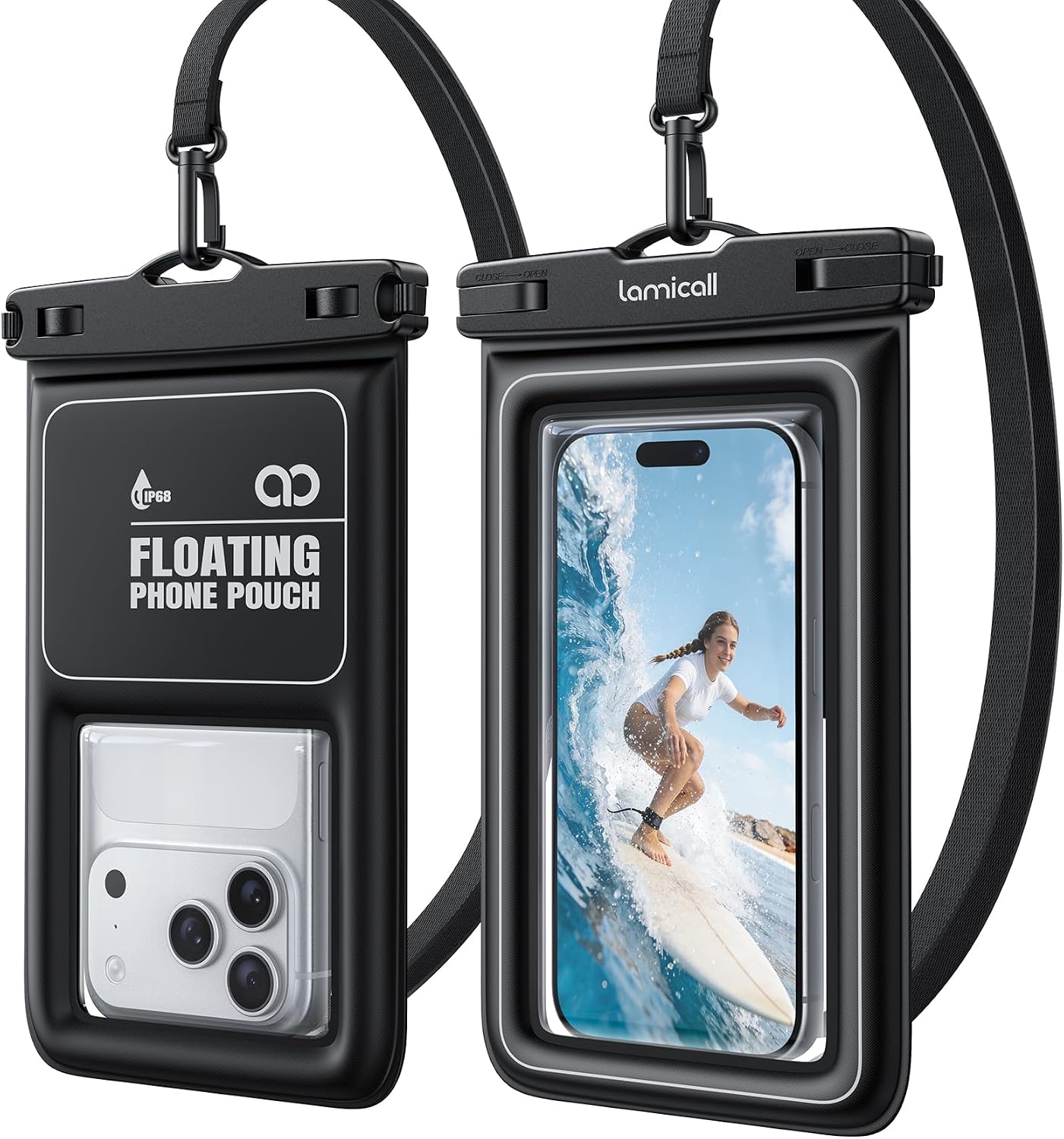
Lamicall IP68 Floating Waterproof Pouch (2-Pack)
A floating IP68 two-pack from Lamicall that swallows anything from a mini phone to an 8.5-inch foldable.
Considerations
- —Big window leaves slack around smaller phones
- —Lanyard is basic compared with crossbody-style straps

6-Pack 8.5" Waterproof Phone Pouches
A six-pouch value pack sized up to 8.5 inches — enough dry bags for the whole boat, cabin, or bachelorette party.
Considerations
- —Per-pouch build quality trails the premium singles
- —No floating claim — clip the lanyard to something that floats

IPX8 Universal Waterproof Phone Pouch, up to 8.4" (2-Pack)
A no-nonsense IPX8 two-pack sized to 8.4 inches, with the clear-both-sides window layout that makes shooting through it easy.
Considerations
- —No float feature — clip it to something that floats
- —Basic lanyard clips feel light-duty

Niveaya Large Floatable Waterproof Pouch, up to 8.5" (2-Pack)
A large floatable two-pack in black and green, with an adjustable lanyard and room for the biggest phones and foldables.
Considerations
- —Oversized window leaves slack around normal phones
- —Green pouch tints photos slightly at the edges
Solids: 6 = dust-tight ('X' = untested)
Water: 8 = continuous submersion past 1m
For a sealed pouch, IPX8 and IP68 protect water equally — your seal is what actually fails.
How to choose
IPX8 vs IP68: both are fine, your seal is what fails
IPX8 and IP68 both certify a product against continuous submersion beyond one meter. The '6' in IP68 adds a dust-tightness rating; the 'X' in IPX8 just means dust wasn't tested, which is irrelevant for a sealed pouch. For choosing a phone pouch, treat them as equivalent water ratings and don't overthink the label. What actually determines whether your phone survives is the closure — and closures fail from user error far more often than from the rating being wrong.
That's why the single most important habit is the tissue test: before your phone ever goes in, seal a dry paper tissue inside the empty pouch, submerge it for a minute or two, and confirm the tissue comes out bone dry. Repeat it whenever you've had the pouch a while, because seals stiffen and clasps wear.
Floatation is worth paying for
A pouch that floats turns a dropped phone from a lost phone into a mild inconvenience. Buoyant designs keep the whole package at the surface instead of sinking into a lake or the sea, and pairing that with a crossbody or wrist lanyard means a fumble becomes a bounce. If you'll be on open water — a boat, a paddleboard, deep snorkeling — floatation is the feature to prioritize over almost everything else.
You can improve your odds further by trapping a little air in the pouch before sealing so it floats screen-up and stays visible. Just remember that the float only helps if the seal is closed correctly; a floating pouch full of water is still a dead phone.
Fit, touch, and the photos you'll actually get
Phones keep growing, and plenty of older pouches no longer fit a plus-size or foldable model with a case on. Check the maximum size before buying; an oversize pouch works for a small phone (with some window slack) far better than a too-small pouch forced over a big one. A snug fit also keeps the window flat against the screen, which helps both touch response and photo clarity.
Speaking of clarity: expect photos shot through any pouch window to be slightly softer and more prone to glare than bare glass. It's the trade for going in the water at all. Keep the window clean and scratch-free, press it flat to the lens, and shoot in good light to minimize the loss. For serious underwater image quality, a dedicated waterproof camera still wins — but for keeping your phone alive and shooting, a good pouch is unbeatable value.
These pouches are for surface and shallow use — swimming, snorkeling, splashing. Pressure at depth can breach a seal that's fine near the surface. Treat depth ratings as a ceiling, not a target.
Go deeper
Protecting Your Phone and Gear Near Water: A Waterproofing GuideWater is the fastest, most permanent way to kill a phone or camera. Here's how to shoot near it confidently — and what to do the moment gear gets wet.
Frequently asked questions
What's the difference between IPX8 and IP68 for phone pouches?+
Both certify submersion resistance beyond one meter. IP68 adds a dust rating; IPX8 simply didn't test for dust, which doesn't matter for a sealed pouch. For water protection, treat them as equivalent and focus on sealing the closure correctly.
Can I take photos through a waterproof pouch?+
Yes. The touchscreen works through the clear window, and you can shoot front or rear photos, even underwater on IPX8/IP68 pouches. Expect images to be a little softer than bare glass; press the window flat to the lens and shoot in good light.
Do waterproof phone pouches float?+
Some do and some don't — it's a specific design feature, not automatic. If you'll be on open water, choose a pouch explicitly rated to float and pair it with a lanyard so a drop stays at the surface.
How do I know my pouch actually seals?+
Run the tissue test: put a dry tissue in the empty pouch, seal it, submerge for a minute or two, and check that the tissue is dry. Repeat periodically, since clasps and seals wear over time.
Will a pouch fit my large or foldable phone?+
Check the maximum dimensions before buying — some pouches now list fit up to 8.5 inches for big and foldable phones. An oversize pouch works fine for a smaller phone; a too-small one won't seal over a large device.
Sources & further reading